 Refrigerators
 Dryers
 Dishwashers
 Stoves
 Freezers
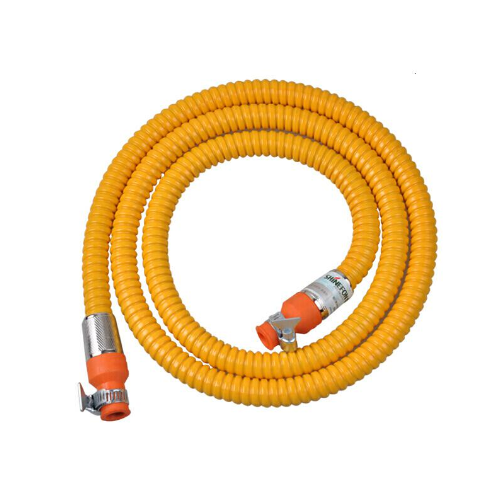
The difference between a gas stove flexible hose and a corrugated hose

Creating a cozy summer home that serves as a peaceful retreat requires careful selection of appliances that enhance comfort without compromising on style or efficiency. At Appliances 4 Less Little Rock, we cater to residents in Little Rock, Benton, Conway, and Pine Bluff with an array of open box, scratch, and dented appliances that are perfect for elevating your summer living. Here’s our guide to the essential appliances for a cozy summer home.
Gas safety is no small matter, 1 a seemingly ordinary connecting pipe, is actually an important line of defense to protect family safety. Rubber hoses, which were widely used in the past, have many potential safety hazards in the complex kitchen environment due to the limitations of their materials and structures. With the improvement of the quality of life and the development of gas equipment, modern families have put forward higher requirements for gas connecting pipes. With its excellent durability, safety and flexibility, metal bellows has gradually become the new standard for gas safety connections.
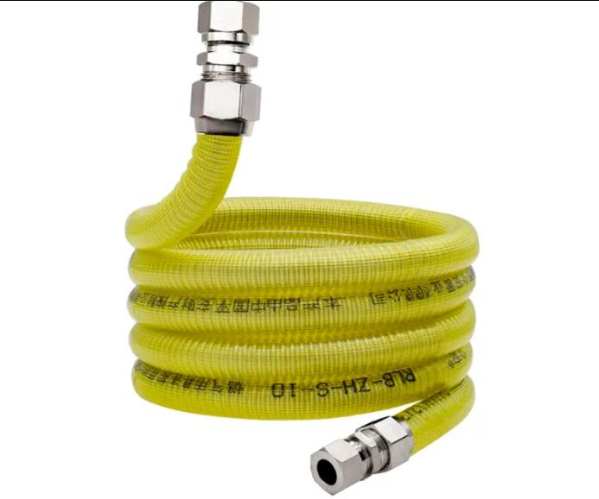
(1)、Rubber hose limitations
Rubber hoses (especially old-fashioned ordinary hoses) are commonly used connecting pipes in the past, and there are many safety hazards.
1. short service life, easy to age
The national standard stipulates that its service life is only 18 months. Rubber is very easy to harden and crack in oil fume and high temperature environment, and there is a risk of leakage.
2. poor anti-injury ability
Afraid of rat bites, scratches and folding. Cabinet corners, sharp objects or mouse bites in the kitchen environment can puncture the pipe wall.
Risk of easy falling off: The rubber material will expand with heat and shrink with cold when the clamp type connection is adopted. The clamp may loosen after long-term use, resulting in air leakage or falling off at the interface.
3. general temperature resistance
Long-term close to the high temperature of the stove, will accelerate its aging process. If you accidentally touch the hot pot bottom, you may be scalded or damaged.
4. relatively low connection firmness
The clamp is usually used for fastening, and there is a potential risk of loosening and falling off under long-term thermal expansion and contraction or vibration.
5. length and shape fixed
Generally, it is of fixed length, cannot be expanded and contracted, the bending radius is required, the installation position is limited, and it is not easy to arrange neatly.
6. only applicable to a few simple scenarios
①. It is generally applicable to the long-term and fixed connection of modern embedded gas stove and valve.
②. It can safely pass through cabinets and adapt to complex installation paths that are curved and need to be bypassed.
No need to strictly rely on ultra-short-term replacement, and its service life of 8-10 years is more suitable for long-term stable use.
④. Because of its resistance to extrusion, high temperature resistance, resistance to rat bite characteristics, can be hidden in the interior of the cabinet, more beautiful and save space.
⑤. With stronger anti-aging ability, it can be competent for the relatively high temperature and humid kitchen environment next to the stove.
⑥. It is a recommended or mandatory product in the safety inspection of gas companies and conforms to the current mainstream safety regulations.
⑦. Reliable connection distance, position is not easy to align the valve and stove, installation flexibility is extremely high.
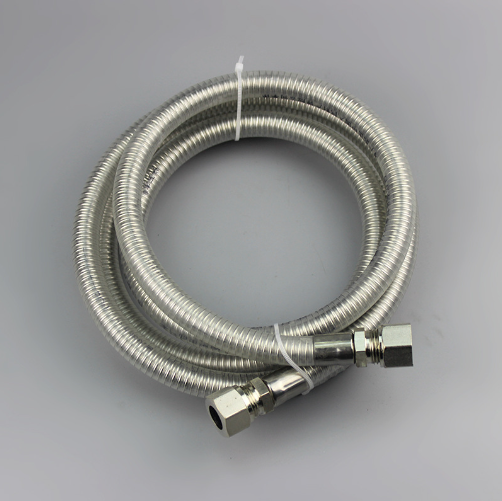
(2)、Upgrade point of metal bellows
Metal bellows (stainless steel material, often wrapped in yellow or metallic PVC protective layer) is the current gas company recommended and installed the mainstream safety products, to solve the pain point of rubber hose.
1. long service life
The service life is up to 8 years (according to national standards), which is much higher than that of rubber tubes and has good stability.
2. excellent durability and protection
Stainless steel material, corrosion resistance, resistance to rat bite. There is usually a PVC or PE flame retardant protective layer on the outside, and the inside is a stainless steel bellows with extremely high physical strength.
3. excellent high temperature resistance and fire resistance
The all-metal structure can withstand extremely high temperatures, which can effectively prevent the stove from being damaged by tempering or accidental flames.
4. the connection is more solid and reliable
The two ends are connected by standard threaded threads (similar to screwing screws). Compared with the clamp connection of the rubber tube, the anti-falling performance is greatly improved and the sealing is better.
5. good flexibility, flexible installation
The pipe body can be bent and has certain flexibility (but it is strictly prohibited to stretch to the limit). Can adapt to different installation angles and distances, easy to clean in a small space line.
6. wider applicable scenarios
①. Modern family standard scene: suitable for connecting the stove with safety self-closing valve.
②. Complex installation scenario: perfectly solve the installation requirements of pipelines that need to wear cabinets, bypass barriers and slightly bend.
③. Safe and durable scene: suitable for long-term settlement families who pursue long-term safety and avoid frequent replacement.
④. Concealed engineering scene: suitable for decoration embedded or need to keep the kitchen beautiful hidden installation.
(4)、Metal corrugated pipe purchase recommendations
1. confirm interface type
Select the corresponding pipe type according to the gas stove and valve interface shape (thread or quick plug).
2. check the certification mark
Be sure to choose a product with a product certificate and a gas-specific certification (such as GC certification).
3. determine the appropriate length
Measure the installation distance and choose a specification slightly longer than the actual distance to avoid pulling deformation.
4. observe the pipe body process
Select the pipe body with smooth surface, uniform corrugation and PVC protective layer.
5. check the completeness of accessories
Confirm that the sealing gasket of the interface is complete and flexible to prevent air leakage.
(5)、Inspection and replacement instructions
1. check
①.Periodically inspect the surface of the metal bellows for scratches, dents or corrosion perforations.
②.Check for leaks or signs of looseness at the joints.
③.Pay attention to whether the bellows has abnormal bending, twisting or stretching deformation during operation.
2. mandatory replacement:
①. Metal bellows use close to 8 years, or rust, damage.
②. The weld of the pipe body is cracked or the corrugated part has obvious defects.
3. precautions for replacement
①. It must be operated by professionals to ensure that the interface is sealed without air leakage, and do not replace it by yourself.
②. Ensure that the specifications, pressure rating and media compatibility of the new bellows are fully matched with the original system.
③.Pre-tension or pre-compression shall be applied in strict accordance with the requirements during installation to avoid forced torsion or use beyond compensation.
④. After the replacement, the system pressure test must be carried out to confirm that there is no leakage before it can be officially put into use.
Conclusion
Although the gas connecting pipe is small, it carries the heavy responsibility of family safety. The upgrade from rubber hose to metal bellows is not only an innovation in materials, but also an improvement in safety concepts. Metal bellows with long life, strong protection, strong connection and other advantages, significantly enhance the use of gas reliability and peace of mind. However, the road to safety has no end. Regular inspection, timely replacement and professional installation are necessary links to ensure the continuous performance of metal bellows. I hope that the interpretation and suggestions of this article can help you build a solid home gas safety line, let technology escort your life, and enjoy a longer and more comfortable cooking and warm time.


